NICHOLAS KATSAFANAS
(2025-2026)
Home
There’s “measurement” and “division”; there’s “self-similarity“ and “syllabic interval”.
There are two crucial elements that, at this point, it’s imperative for us to define if we’re going to continue to write in metrical structures. The first is the syllable, which is a simple unit; the syllable is unitary, a simple mathematical unit. But the second element is the echo. The echo is relational, something that exists only as a derivative of the unitary syllable. The echo is a mist, a notable participation in Likeness across two or more of these units, separated by a reasonable spatial distance, connected temporally via speech.
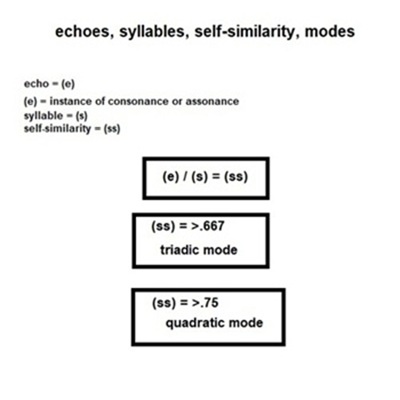
The echoes, in aggregate, become a measurement of self-similarity.
The line or block of text is composed of “syllables” and the echoes are the “measurements of likeness” between these fundamental elements. This will be the case for either in an individual line or a block of text that’s then either left as a block or then diced up into set intervals after the fact.
The section or sentence is a “self-similar line”, and the text is a “self-similar wave”, both of which come into being via measurement. The measurement defines the “mode” — a quotient range (>.667; .650-.800, etc) is just a variable restriction, like a mode.
These blocks of text could also be called “macrotones” in a sense, and by that I mean they have a measured quotient of self-similarity (which expresses itself via sound) that defines the unit, that can’t be divided without changing essentially. A macrotone of .754 even if divided equally into two will change essentially, it will no longer be .754. Whereas a microtone takes a tone and divides it — a macrotone is an aggregation of sound.
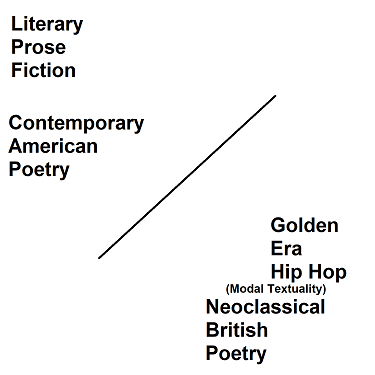
But the best example of all of this isn’t in Whitman or Pound or Ginsberg or Ashbery; it’s just the last line of the first verse of Big Pun’s “Twinz.”
“Dead in the middle of Little Italy little did we know
that we riddled some middleman who didn't do diddily”
“[D]ead [i]n the [m][i][d]dle of [L][i]ttle [I]t[a][l][y] [l][i]ttle [d][i]d we know
that we r[i][d]dled some [m][i][d]dle[m]an who [d][i][d]n't [d]o [d][i][d]d[i][l][y]”
[31]:31 1.00
Instead of sentences and paragraphs the fractal novel is comprised of extended lines and echoes.
To properly map echoes and extended lines, Microsoft Excel has been repurposed from the catacombs of corporate finance as an alternate word processor.
(The modern novel has incorporated photography (Sebald), but has it really integrated cartography to any meaningful degree?)
The concept of the echo was borrowed from Byzantine Middle Eastern microtonal music.
For the purpose of fractal prose, it's a sum of consonance and assonance.
These echoes ricochet through the extended line to approach 1:1 self-similarity (i.e. 1 repetition for every 1 syllable).
These echoes, designated by [brackets] in the original texts, rip apart the extended line, dividing single words and even syllables into multiples.
Microsoft Excel is repurposed to map out said multiplicities using the TEXTSPLIT and Conditional Formatting functions.
Summary: The fractal novel is a recycle bin repurposing the Echo from Byzantine Middle Eastern microtonal music and Microsoft Excel from the banality of corporate finance.
It consists of (3) versions of a single text:
01. The Original Text: [Bracketed] with Echoes (the original source document)
1A. The Legible Text: Derived via Ctrl+H for Legibility (read like any other work of fiction)
1B. The Cartographic Text: Derived via TEXTSPLIT for Cartography (a diagrammatic map)
The self-similarity of “1.00” — peak fractal lyricism? There are no fixed syllables per line here, and there’s no fixed pattern of stressed syllables, and there’s no technical end-rhyme, because although “Italy” and “diddily” might technically rhyme, in the incessant referencing back upon itself of the line, this outright rhyme is diluted by various the D’s, soft I’s, and L’s that ricochet violently across the line, engaging in fractional portions of consonance and assonance. An echoing. What I might even call a modal slant rhyme.
American composer Robert Ashley was chiefly concerned with: (a) creating a new meter for American English, and (b) creating extended narratives in that meter.
The performance of these texts would comprise his cycle of operas.
While the rap of the 90s and 00s re-emphasized the role of metrical considerations in English, it was generally relegated to shorter forms.
The fractal novel is a result of this form. Where the echoes (aggregated repetitions) in the line approach 1:1 with the total syllables of the line (self-similarity).
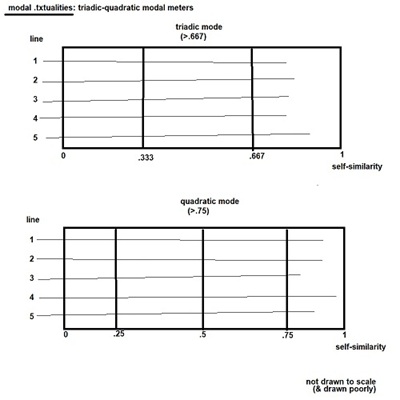
A modality of this arrangement can be achieved by dividing the oneness of the line into various segments.
You could create a triadic mode where the self-similarity lands in the Third Triad (i.e. Self-Similarity = >.667).
You could divide into fourths for a Quadratic Mode (i.e. >.75). The more divisions of Ones the closer you'll approach 1:1. And so on ...
2gyrox(at)gmail(dot)com
Home